Human Subjects System (HSS)
Does your study involve human subjects? NIH-funded research with human subjects requires a submission of a study record via the Human Subjects System (HSS). Note that this is also required for projects that consist of secondary data analysis.
Learn more about the HSS in this user guide and video tutorial.
What information will I need to submit?
- A Clinical Trial Questionnaire with yes or no questions:
- Does the study involve human participants?
- Are the participants assigned to an intervention?
- Is the study designed to evaluate the effect of the intervention?
- Is the effect that will be evaluated a health-related biomedical or behavioral outcome?
- Performance site address
- Conditions or focus of study
- Information about the study participants:
- Eligibility criteria
- Minimum and maximum participant age
- Inclusion of individuals across the lifespan
- Inclusion of women and minorities
- Recruitment and retention plan
- Protection of human subjects
- Study timeline
- Participant enrollment dates (actual or anticipated)
- Inclusion Enrollment Form: download CPRC's template here.
If your study consists of ONLY secondary data analyses:
Most CPRC researchers conducting secondary data analyses will need to complete sections 1.1 - 3.2 as listed in the HSS user guide. Make sure your sections explicitly state that the research consists of secondary data analyses.
Download the below template for secondary data analysis submissions.
If your study involves primary data collection:
Most CPRC researchers collecting primary data will need to complete sections 1.1 - 3.2 as listed in the HSS user guide.
Download the below template for primary data collection submissions.
How to submit:
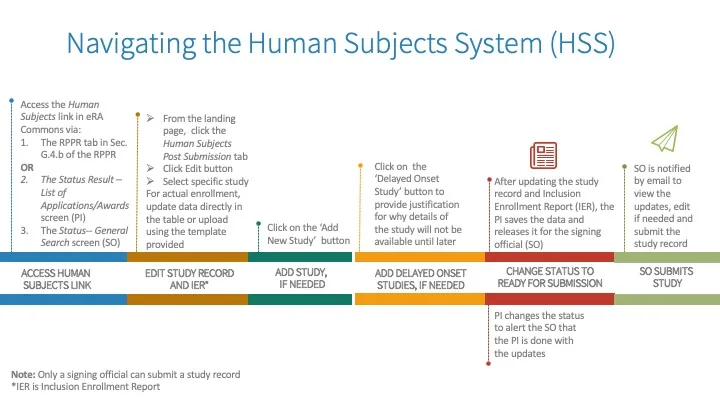
The study investigator can upload the files to the eRA Commons website, the main HSS platform for researchers. The image below outlines the submission process. Find more information on how to navigate the eRA Commons here.