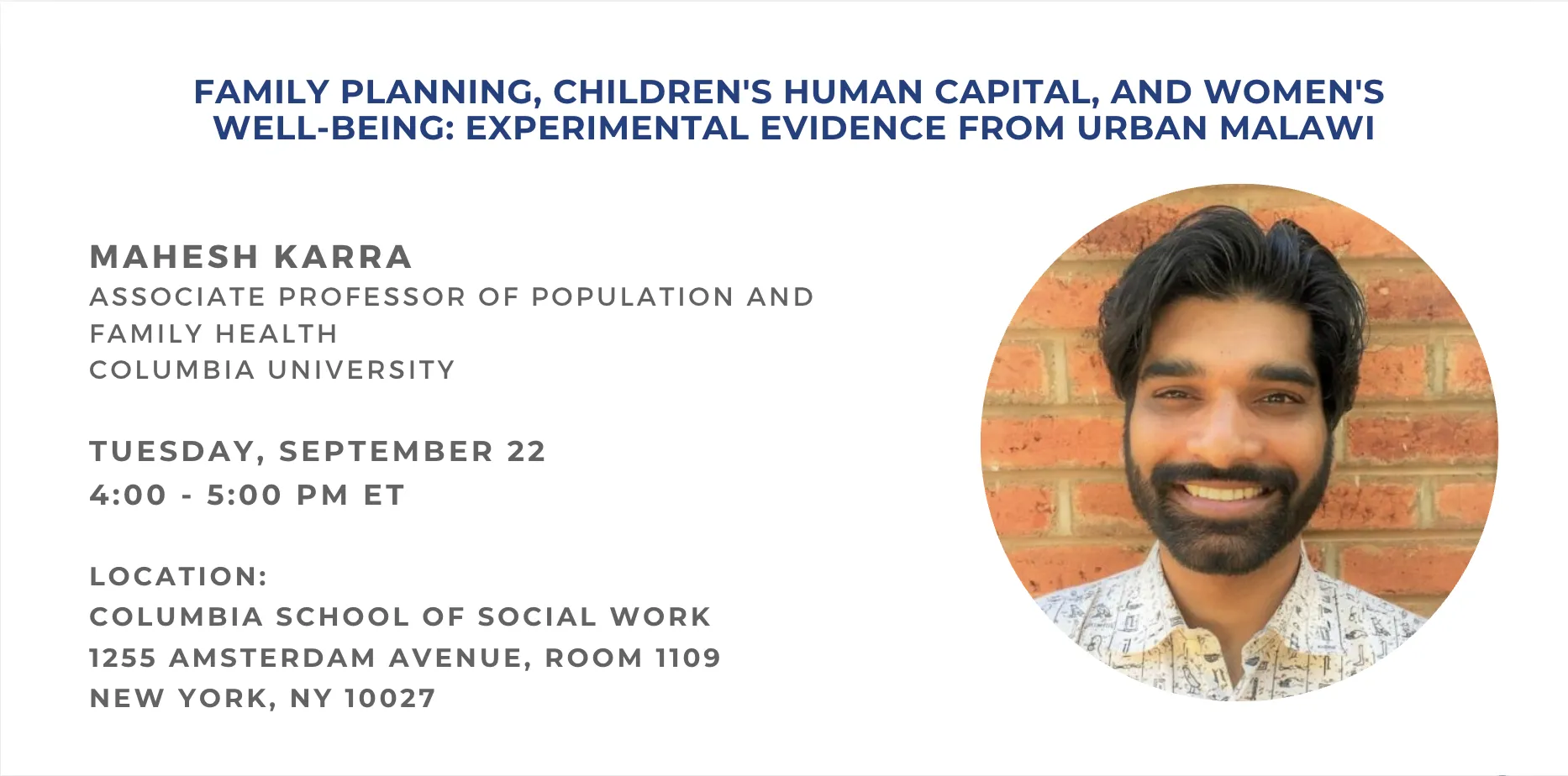
Family Planning, Children's Human Capital, and Women's Well-Being: Experimental Evidence from Urban Malawi
I present findings from a randomized controlled trial in Malawi that identifies the causal impact of a comprehensive intervention to improve access to family planning services. Married women who were either pregnant or had recently given birth were randomly assigned to either an intervention arm or a control arm. Women who were assigned to the intervention arm received a package of services over a two-year period that included: 1) a family counseling; 2) free transportation to a high-quality family planning clinic; and 3) reimbursements for family planning services, including for the treatment of contraceptive-related side effects. We find increases in contraceptive use (by 5.8 p.p.), driven by an increase in long-acting method use (by 5.5 p.p.) after two years of intervention exposure. Women in the intervention group were also 43.5 percent less likely to be pregnant within two years of their previous birth relative to the control group. In addition, we find that women who were assigned to the intervention arm were 5.3 p.p. more likely to be employed after two years of intervention exposure. This increase in employment is driven by a 4.5 percentage point increase in wage-earning labor. Women's fertility preferences and subsequent likelihood of unintended pregnancy were also impacted by the intervention. Finally, we find that children born to mothers assigned to the intervention arm were 0.34 SD taller for their age and scored 0.23 SD higher on measures of cognitive development after two years of intervention exposure. Taken together, these findings suggest that improved access to family planning may have positive downstream effects on health that extend beyond impacts on contraceptive use and fertility alone.
Mahesh Karra is an Associate Professor of Population and Family Health at Columbia University’s Mailman School of Public Health and the Director of the Program on Women’s Empowerment Research (POWER). He was also an Alexander von Humboldt Fellow at the University of Göttingen’s Center for Modern Indian Studies from 2024-2025. His academic and research interests are broadly in development economics, health economics, quantitative methods, and applied demography. His research utilizes experimental and non-experimental methods to investigate the relationships between population, health, and economic development in low- and middle-income countries. He has conducted field work in Sub-Saharan Africa, South Asia, and Latin America, and his current research uses randomized controlled trials to evaluate the health and economic effects of improving access to family planning and maternal and child health services in Malawi, India, Nepal, Sri Lanka and Tanzania. He has also worked for the Population Reference Bureau and the Futures Group International and served as a consultant to the World Bank, the World Health Organization, and the Population Council. He is a Co-Editor of Studies in Family Planning, a quarterly peer-reviewed academic journal that publishes articles on public health, social science, and biomedical research on sexual and reproductive health, fertility, and family planning.