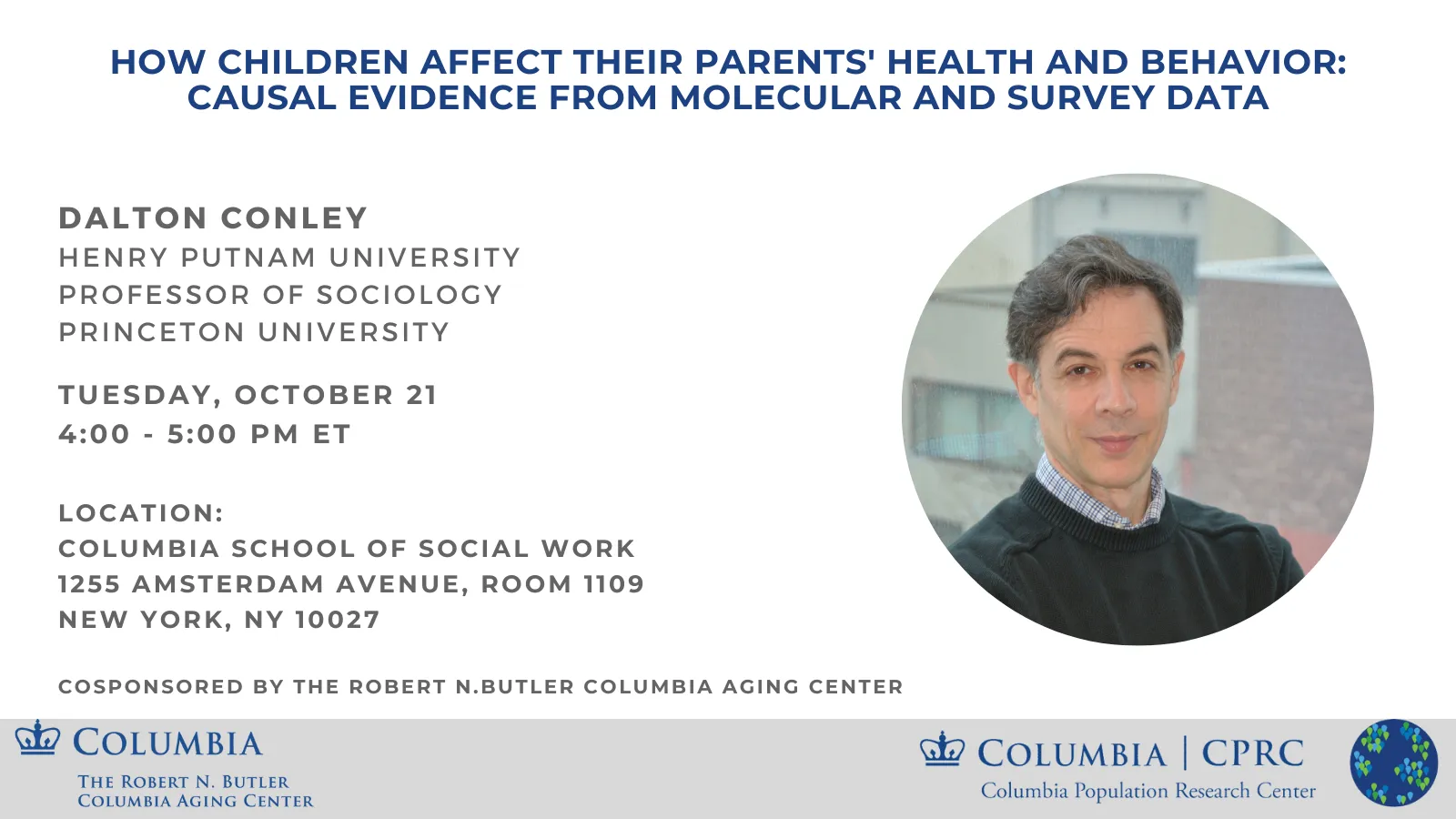
How Children Affect Their Parents' Health and Behavior: Causal Evidence from Molecular and Survey Data
The typical model of human development is unidirectional: From parent to child. However, growing evidence suggests that children exhibit causal changes in their parents' political views, health, and behavior. This talk will show how we can use molecular (i.e. genomic and epigenetic) data combined with survey responses to identify causal effects of children on their parents. I will focus on three aspects of children that impact their parents: the number of offspring, sex, and genotype. I show that children, from a very young age (~18 months), guide their parents in how to raise and invest in them. Meanwhile, combining instrumental variable estimation of the impact of fertility on epigenetic aging clocks and other health measures provides causal estimates of the developmental toll children evince on their parents. Contrary to evolutionary theory, female children age their parents (and particularly their mothers) the fastest.
Dalton Conley is the Henry Putnam University Professor in Sociology and a faculty affiliate at the Office of Population Research and the Center for Health and Wellbeing at Princeton University. He is also a Research Associate at the National Bureau of Economic Research (NBER), a faculty affiliate at the New York Genome Center, and in a pro bono capacity he serves as Dean of Health Sciences for the University of the People, a tuition-free, accredited, online college committed to expanding access to higher education.
Cosponsored by the Robert N.Butler Columbia Aging Center