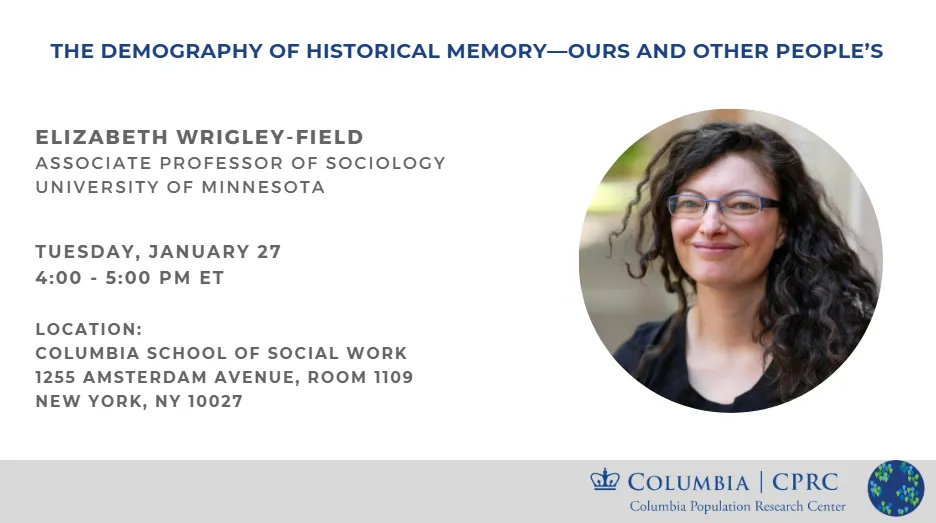
The Demography of Historical Memory—Ours and Other People’s
Abstract: Recently, demographers have begun to develop models for how individuals carry the past into the present -- that is, how the core population processes of births, deaths, and migrations crystallize the portion of a population, at any given moment, that directly experienced a significant historical event. Yet individuals don’t only carry our own memories; the salient experiences of our kin also shape how we view the world, and demography also constrains what portion of a population is tied to an event through the experiences of close kin. This project aims to develop rigorous models of experience and historical memory as they are carried through family ties, and use them to develop novel, testable hypotheses about how demography has constrained and enabled political and cultural change. I am developing these ideas initially in the context of the Black freedom struggles in the United States, but they are more general in application.
Elizabeth Wrigley-Field is an associate professor at the University of Minnesota. A sociologist and demographer, she studies racial inequality in mortality in the historical and contemporary United States, and specializes in finding comparisons and metrics that illuminate the human meaning of mortality disparities. She has extensively researched the Covid-19 pandemic in Minnesota, where she also co-founded an award-winning community vaccination organization (the Seward Vaccine Equity Project). She is also a demographic methodologist, developing models designed to clarify relationships between micro and macro perspectives on population processes. The article she recommends people read as the best introduction to her work is her 2025 article in the Annual Review of Sociology, "Three Ways of Looking at Black - White Mortality Differences in the United States."