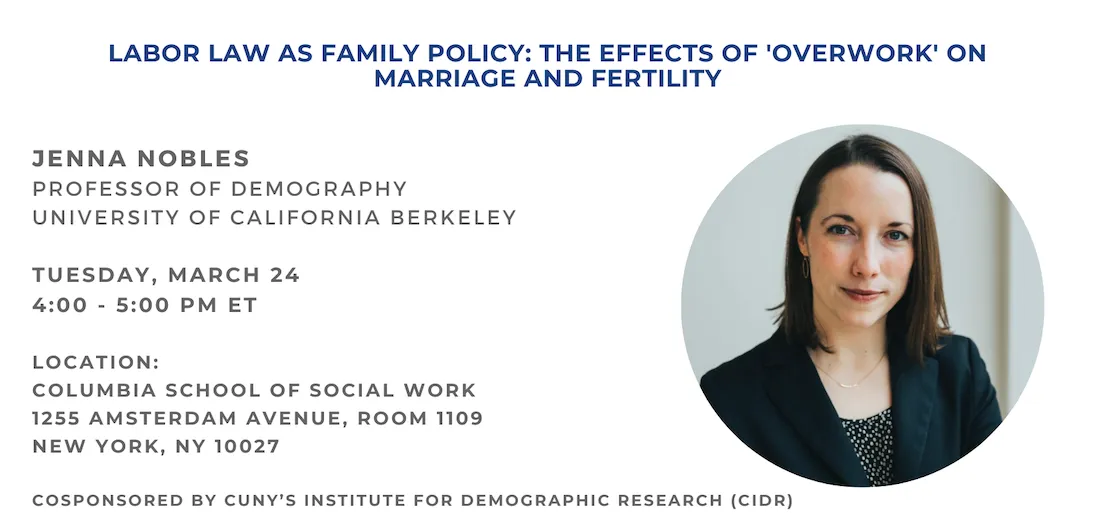
Labor Law as Family Policy: The Effects of 'Overwork' on Marriage and Fertility
Abstract: Amidst ongoing fertility decline in high-income nations, policymakers are considering multiple approaches to support people’s ability to partner and have children. A primary critique of single cash transfer or parental leave policies is that they have short-term effects and change little about enduring demands on families. An alternative approach includes policies that are not explicitly pronatal but instead structurally improve people’s work and home lives, and in so doing, create conditions that better support family growth. We test the marriage and fertility effects of policies aimed at capping “overwork” culture in South Korea. We demonstrate that long working hours causally reduce marriage entry and childbearing. The effects are larger for women than men but meaningfully sized for both groups. In the absence of federal policies that capped working hours first in 2004 and again in 2018, fertility in Korea would be about 10% lower than it is today. The findings not only demonstrate rare evidence of policy that meaningfully supports family building; they also underscore the significant individual and societal costs of overwork.
Bio: Jenna Nobles is Professor and Chair of Demography at the University of California, Berkeley. She studies the effects of migration on sending and receiving communities; population variation in fecundity and fertility; and the effects of environmental conditions on population processes. She currently leads a research team studying the social and environmental causes of conception delay and miscarriage using georeferenced mobile device data. She received the Clifford C. Clogg and Early Career Awards from the Population Association of America.